John Piper Should I Get Baptized Again
Does everyone who joins a local church building demand to be baptized? What'due south the relationship betwixt baptism and church building membership (and even more fundamentally, betwixt baptism and the Lord's Supper)? Should baptists allow those sprinkled as infants join their churches?
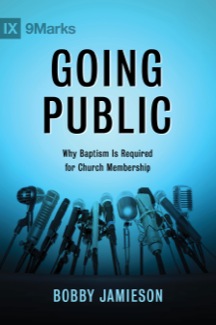
These are but some of the thorny issues Bobby Jamieson tackles in his new bookGoing Public: Why Baptism Is Required for Church Membership(B&H Academic, 2015) [50 quotes | audio interview | summary chapter].
I recently spoke with Jamieson—a PhD student in New Attestation at the University of Cambridge and the author of Sound Doctrine: How Church Grows in the Love and Holiness of God(Crossway, 2013) [review];Understanding Baptism(B&H, 2016); andUnderstanding the Lord's Supper(B&H, 2016)—almost why he thinks Charles Spurgeon and John Piper are incorrect, common objections to the "closed membership" position, why this practically matters, and more than.
Why do you lot think believer'due south baptism is required for church membership?
Church membership is a public affidavit of someone's public profession of faith in Christ, and Jesus has appointed baptism as the means by which his followers publicly profess their religion in him. A church building can't affirm the profession of someone who hasn't yet made that profession.
Baptism is how you publicly place yourself with Jesus and with his people (Acts ii:38–41). It's how you visibly signify that you lot are united to Christ in his death, burying, and resurrection (Rom. 6:1–4). It's how y'all are identified before the church and the world as one who belongs to the Triune God (Matt. 28:19).
Baptism is where faith goes public. Information technology's how you nail your colors to the mast as Jesus's disciple.
Baptism is like a jersey that shows you're at present playing for Jesus's squad. A church building may publicly place itself only with those who have publicly identified with Jesus in baptism.
I know many TGC readers understand Scripture to teach that the infant children of believers should be baptized. I disagree, with no less honey and affection for those with whom I differ.
If baptism is where faith goes public, and so infant baptism simply is not baptism, and those who have been "baptized" every bit infants need to be baptized—for the start fourth dimension—as believers.
I take bang-up respect and affection for evangelical paedobaptist brothers and sisters. Some are among my closest friends and theological heroes. And the vast majority of their churches agree that you lot must be baptized in order to bring together. It's simply that nosotros disagree about what counts as baptism!
In his biography of Charles Spurgeon, W. Y. Fullerton recounts an interesting chestnut from Spurgeon:
He once told me with appreciation how he was worsted in statement by an American divine. During a drive, the visitor made a number of inquiries, and discovered the practice of the church . . . how information technology admitted people to the Lord'due south Table who were not baptized, and refused them membership unless baptized. "Which ways that they are adept enough for the Lord, and yet not skillful enough for you lot!" said his guest. And Spurgeon had to admit that the logic was not on his side.
This reasoning feels so self-plain true to many. They have a hard time imagining withholding membership in a local church from someone Christ welcomes into his universal church. Why do yous think open membership "simply feels right?"
I remember the instinct that a church should never exclude from membership a professing laic whom they're confident is a Christian is almost exactly right. The only trouble is, baptism fits within the box marked "How a Church Knows Someone Is a Christian." Baptism isn't a split up requirement for church membership in addition to a profession of faith; it is how someone publicly professes organized religion.
But why is this instinct so widespread? Evangelicals, as a movement, are massively invested in interdenominational cooperation. I think this is largely benign, and TGC is a fine example of the good such cooperation can accomplish. But information technology's easy to think that if we agree about the essentials of the gospel, there's nothing that can legitimately divide u.s.a.—like baptism, or church government—even if God has clearly spoken to such matters in his Word.
In a more extreme form, some evangelicals can be impatient with any doctrinal distinctives that aren't "essential to salvation." Some desire to nail down the blank minimum and non get hung upwardly over annihilation else. Simply in the long run, neglecting everything that'due south not the gospel will undermine your ability to preserve the gospel.
I'm going to state some of the virtually common and compelling objections to your (closed-membership) position. How would you respond in less than 200 words each?
(A) John Piper has written:
When I counterbalance the kind of imperfection involved in tolerating an invalid baptism because some of our members are deeply persuaded that it is biblically valid, over against the imperfection involved in saying to a son or daughter of the living God, "You are excluded from the local church," my biblical sense is that the latter is more unthinkable than the quondam. The local church is a visible expression of the invisible, universal, trunk of Christ. To exclude from it is virtually the same as excommunication. . . . Very few, it seems to me, take really come to terms with the seriousness of excluding believers from membership in the local church. It is preemptive excommunication.
In other words, it's wrong for a church to exclude anyone from membership whom they're confident is a Christian.
First, if excluding from membership anyone whom you're convinced is a Christian is tantamount to "preemptive excommunication," and then Piper's charge, in principle, rolls back on himself. For instance, his church building's congregational affirmation of religion, which members must affirm, confesses that the Bible is "fully inspired and without mistake in the original manuscripts." I affirm this, but there are plenty of people both Piper and I would happily recognize every bit Christians who don't. And then I tin't see how Piper's own practice would avoid falling nether the same judgment of "preemptive excommunication."
Further, Jesus only hasn't given the church building the authority to assert the professions of those who haven't publicly professed religion in him. If you refuse to cosign your identity by providing the PIN for your debit menu, the grocery store is not authorized to charge your carte and give y'all your groceries. (Even if you have the money in your depository financial institution account!) Too, at an drome, if you refuse to identify yourself as a passenger past producing a boarding laissez passer, the gate agent is non authorized to let you lot on the airplane. (Fifty-fifty if you paid for a ticket!)
As I fence at length in the book, baptism isn't asufficient criterion past which the church building is to recognize Christians, just it is a necessary one. It's not enough for someone to merits to be a Christian or for everyone in the church to think someone is a Christian; Jesus has bound the church's judgment to baptism.
(B)This is an issue that should be left to private consciences rather than beingness a standard of fellowship.
Baptism is something Jesus requires the church to do, not just individual Christians: an individual gets baptized, but the church baptizes. Therefore, a church is not at liberty to allow individual Christians to determine what baptism means and whether they take been baptized. Do we allow believers' consciences to trump the church'southward convictions in other areas of church-constituting doctrine and practise?
(C)Information technology'southward wrong to requite baptism membership-defining status when agreement about other, weightier doctrines isn't required for membership.
To call other doctrines "weightier" than baptism is to treat doctrines as if you can stand them all on a calibration one by i, mark each weight on a list, and then sort them from lightest to heaviest. This reasoning assumes baptism is fundamentally like any other doctrine you might put on the calibration. Simply baptism isn't only a doctrine; it'due south a practice. And, along with the Lord's Supper, baptism actually gives shape and structure, form and order, to the local church. Y'all can't make "Christians" into "church building" without baptism and the Lord's Supper. Baptism binds one to many and the Lord'due south Supper makes many one. Baptism accomplishes something essential for the being of the local church.
And then a church needs to concur about who should be baptized, and who actually is baptized, in order to unite as a church using the ways Jesus himself has appointed.
(D)Information technology's inconsistent to exclude paedobaptists from membership while inviting them to preach in your church building.
Fellowship between Christians isn't all-or-nada. Church membership isn't the just kind of fellowship Christians can have. I call back we should cooperate as Christians, and as churches, to the fullest extent that our shared convictions allow. We see in 2 Corinthians viii:18 and 3 John 5–6 that the earliest Christians would occasionally hear trusted preachers from other churches. While I exercise recall baptism is meant to depict the line of church building membership, credobaptists and paedobaptists should partner together in all sorts of ways: friendship, mutual encouragement, prayer, evangelistic outreach, developing and promoting biblically faithful resources, and much more than.
Imagine some open-membership baptists now say, "Alright Bobby, we've put y'all on the defensive long enough. Turn the tables." What primary objection of your ain would you offer?
Well, my open-membership friends, that'southward very kind of y'all to invite my critique! Non to mention kind of y'all to have read this far.
The chief objection I would offering to removing baptism from the requirements for membership is that baptism is what constitutes and confers membership. It'due south like the vow in a spousal relationship. There'due south disanalogy hither, of course, in that Christians can be baptized in one church and and so later bring together another. Just removing baptism from membership is like removing the vow from matrimony: take away baptism and what's left isn't church membership, merely a label that lacks the reality.
One of the reasons Jesus instituted baptism and the Lord'southward Supper is to mark off his people from the world. Baptism has that church building-marking, customs-creating part. Baptism initiates the human relationship; "church membership" only recognizes and names information technology.
So I would say to open-membership credobaptists that they are, however unintentionally, blurring the line Christ has drawn between the church and the world and drawing i of their own.
It seems like the goal of this book isn't merely to convince people to require baptism for membership, just to re-shape how we call back near membership altogether. Is that off-white? If then, what are we missing about membership?
Yeah, that'south exactly right. What modern, Western evangelicals tend to miss most membership is that it starts with, and is shaped by, the ordinances of baptism and the Lord's Supper. Actually, I think this is ane reason why some people are hesitant to see formal membership in the New Testament. Where are the names on the rolls, the classes, the interviews, the formal process? Well, those elaborated processes may not be nowadays in the New Testament, but baptism and the Lord'southward Supper are. And those two ordinances be precisely in society to join a believer to the church, and join the church together as one body.
Because nosotros've allowed the ordinances and membership to drift apart, we've privatized and individualized the ordinances, and we've minimized the biblical basis for membership. Instead, when nosotros run into baptism and the Lord'south Supper in the New Testament, nosotros should recollect "church membership," and when we consider the basis for, and practice of, church membership, nosotros should think "baptism and the Lord'south Supper."
I'm non saying at that place's no place for a careful, thought-through membership process. Instead, I'g saying that a correct view and do of the ordinances requires church membership, and a right view and exercise of membership requires the ordinances.
How does this issue matter on a applied level?
In i sense I care more about churches regaining an agreement and practice of baptism and the Lord'southward Supper every bit community-forming—as binding ane to many (baptism) and binding many into one (Lord'due south Supper)—than I do about whether every reader agrees with my conclusion that believer's baptism should be required for church building membership. The volume aims at that narrow bespeak, but the broader one is every bit of import. And information technology might have even more than implications for the life of the church building.
For example, if baptism is the forepart door of the church, so churches should, as a rule, only baptize people into church membership. There's no "I'm with Jesus but not withal with the church building" stage. If you get public as Jesus's disciple, yous bring together his public people. And if a church building baptizes people into membership, they say from the beginning that the Christian life is lived in the local church. You lot explode the myth of the solitary-ranger Christian. You help ensure that "body of Christ" and "family of God" aren't dead metaphors but living truths that help define what it means to follow Jesus for everyone who comes to know him through your ministry building.
Source: https://www.thegospelcoalition.org/article/is-baptism-required-church-membership/
0 Response to "John Piper Should I Get Baptized Again"
Postar um comentário